What to verify before an alternate is accepted
- Match the pin legend. For a T568B discussion, ask whether the display expects pairs 1-2, 3-6, 4-5, and 7-8, and how it flags a split pair.
- Match the impedance discussion. Twisted-pair notes often use a 100 ohm nominal figure. Ask whether this handheld reports impedance or only continuity.
- Match the length formula. If the buyer cares, request the printed tolerance, for example plus or minus 1 percent of reading plus 1 m, and the reference cord length used at incoming check, such as 50 m.
- Match the evidence pack: datasheet date, calibration traceability if offered, safety category if the screen shows voltage, and any FCC or NRTL file that names this model.
Insertion loss on copper, when requested, is a category limit at a stated frequency. Do not paste a fiber 0.5 dB figure into an RJ45 cell. Optical budget, wavelength, and dispersion stay on the fiber brief. Switching capacity, gain, and VSWR stay off this copper page unless the model is a different instrument and the sheet says so.
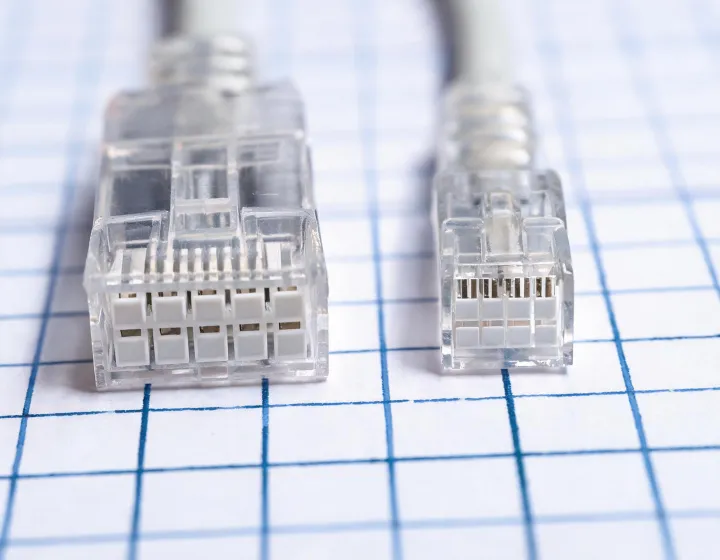
Sourcing scenario for a hotel retrofit: the background is a mix of RJ45 room drops and a few RJ11 handset runs, with 9 technicians sharing identifiers. The process is to demand one model string that lists both ports, eight RJ45 remotes, and two RJ11 leads, and to reject a photo that shows only the RJ45 face. The result is an alternate that is either explicitly dual-port or explicitly labeled as RJ45-only with a separate RJ11 tool. Review names on the catalog before the form is sent.
Ingress protection and connector mating cycle counts matter when the kit lives in a truck. Ask for the IP code and the cycle count only if the sheet prints them. A missing code stays blank. TIA-568 and IEEE 802 language can name the plant. They do not close the alternate.